
Render vs Vercel: Cloud Hosting for Apps and Agents
Render focuses on full-stack cloud infrastructure with managed databases and HIPAA compliance, while Vercel optimizes for rapid frontend deployment and serverless functions. Developers needing backend services and strict compliance should lean toward Render, whereas teams prioritizing quick CI/CD and global CDN delivery will prefer Vercel. Both platforms serve as indie alternatives to traditional cloud providers.
Last verified against both official websites on November 8, 2026
Render
Render is a cloud platform for hosting web services, databases, and agents, featuring static site deployment, autoscaling, and HIPAA compliance.
Choose Render if you need a unified platform for hosting web services, background workers, and managed Postgres databases alongside your frontend.
Official site Indie alternatives to Render
Vercel
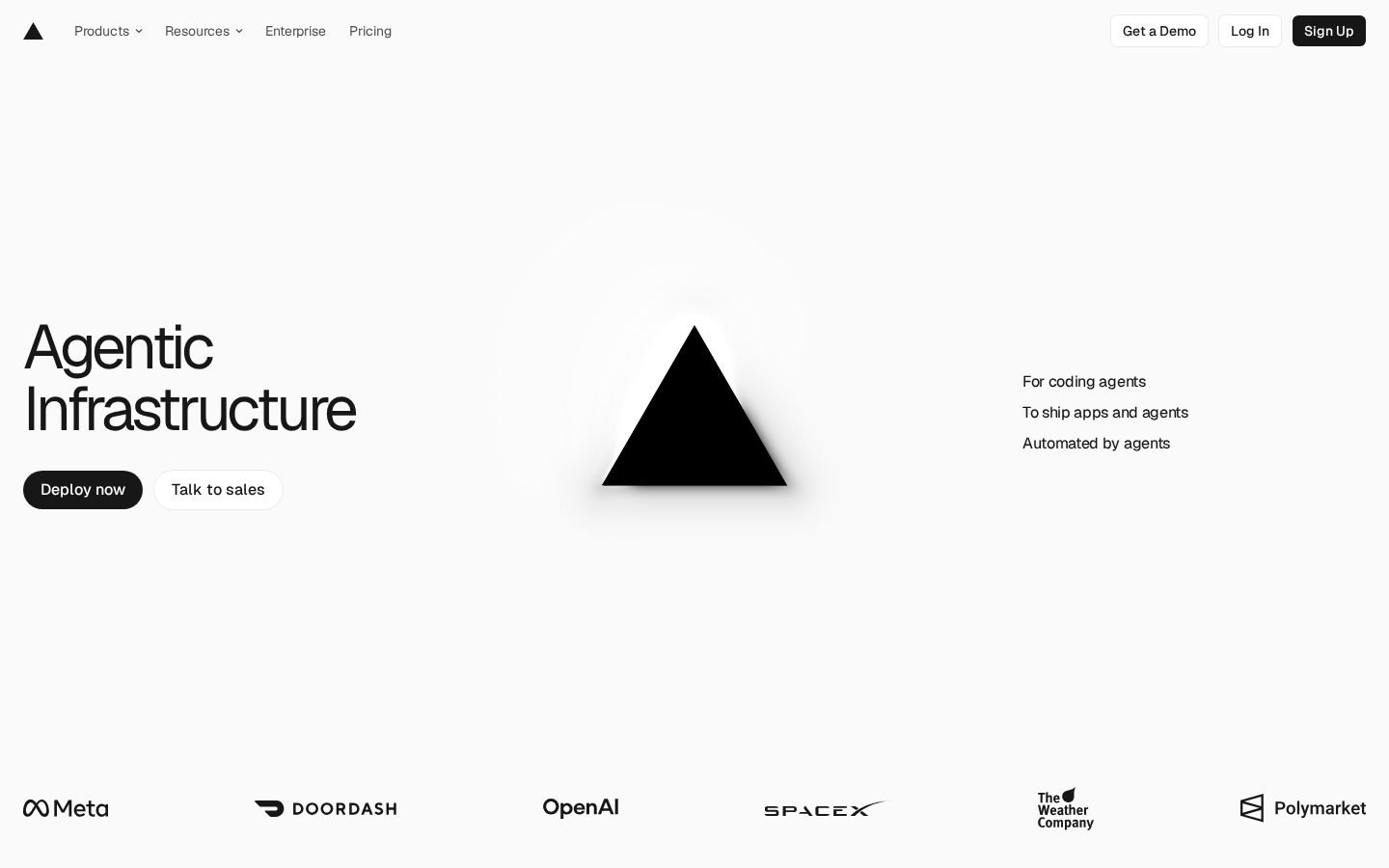
Vercel is a platform for deploying web apps, AI agents, and platforms, offering features like CI/CD, global CDN, serverless functions, and agent infrastructure.
Choose Vercel if your workflow centers on automated CI/CD pipelines, serverless functions, and a global CDN for fast static and dynamic content delivery.
Official site Indie alternatives to Vercel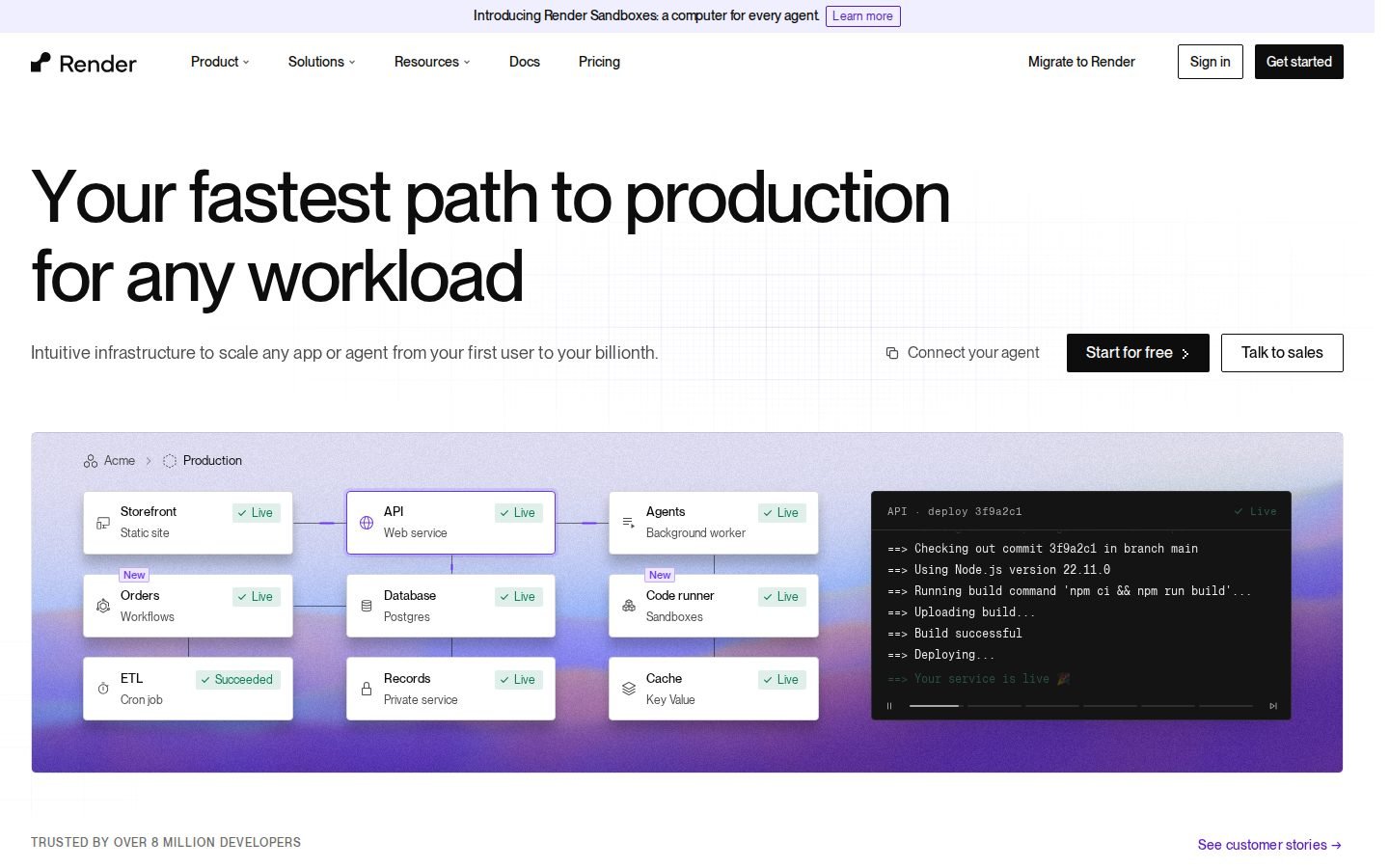
Render vs Vercel pricing
| Render | Vercel | |
|---|---|---|
| Free plan | Yes | Yes |
| Free trial | Start for free | 7 days |
| Plans |
Static Sites
Free
Deploy websites for free, forever
HIPAA-enabled workspace plans
$499/mo
Includes a self-serve BAA and live chat support
|
Hobby
Free
Perfect starting place for personal projects
Pro
$20/mo
Popular plan for scaling apps
Enterprise
Not listed
Critical security and performance
|
Prices as shown on each official pricing page when last verified (our servers are in the EU, so some sites show local currency). Check the official site before buying.
Features compared
| Feature | Render | Vercel |
|---|---|---|
| Free plan available | Yes | Yes |
| Managed databases | Postgres, Key Value | Not listed |
| Serverless functions | Not listed | Yes |
| Global CDN | Not listed | Yes |
| HIPAA compliance | Yes | Not listed |
| CI/CD automation | Not listed | Yes |
| Background workers | Yes | Not listed |
| AI agent support | Yes | Yes |
| DDoS mitigation | Not listed | Yes |
| Load-based autoscaling | Yes | Not listed |
Purpose & Architecture
Render positions itself as a comprehensive cloud platform for hosting web services, databases, and AI agents. It caters to developers, startups, and enterprises building APIs, data pipelines, and scalable applications. Full-stack infrastructure in one dashboard covers both frontend and backend needs.
Vercel specializes in deploying web applications and AI platforms with a strong emphasis on developer velocity. It targets developers, businesses, and teams looking for streamlined workflows and edge delivery. Rapid deployment with global edge caching keeps content close to users.
Key Capabilities
Render provides managed Postgres databases, Redis-compatible key-value stores, and background workers for asynchronous tasks. It also supports cron jobs, private services, and load-based autoscaling for predictable performance. Managed databases and background workers reduce operational overhead.
Vercel emphasizes automatic CI/CD, serverless functions, and a built-in web application firewall. Its Fluid Compute and DDoS mitigation features handle traffic spikes while sandboxed VMs isolate workloads. Automated pipelines and serverless functions accelerate release cycles.
Pricing & Limits
Render offers a free tier for static site hosting and charges $499 per month for HIPAA-enabled workspace plans. The platform does not list a standard paid tier for general web services, focusing instead on custom or compliance-focused pricing. Static hosting remains free forever for simple projects.
Vercel structures its pricing around usage tiers, starting with a Hobby plan at $0 and a Pro plan at $20 per month. The Pro tier includes a $20 usage credit, while Enterprise pricing remains custom. Predictable monthly tiers help teams budget scaling efforts.
User Experience & Trade-offs
Users on Hacker News often highlight Render’s ease of deployment for high-traffic applications. However, some note that free tier instances may be too small, and cold starts can cause slow initial page loads. High-traffic apps deploy smoothly despite occasional latency.
Vercel receives praise for its seamless integration with modern frameworks like Next.js and Nuxt. Community feedback points out that bandwidth pricing can be higher than competitors, and the Hobby plan restricts commercial use. Framework-first workflow simplifies modern stack management.
What users say
Render
Vercel
- High bandwidth pricing compared to competitors [1]
Summarized from public Hacker News discussions; links go to the original comments.
Indie alternatives to Render and Vercel
Smaller tools built by independent makers that cover part of what these two do, often for less.

Inquir Compute
Cloud platform for apps databases and background jobs
The website explicitly lists 'Render Alternative: Background Jobs and Services' and competes by offering managed containers, databases, and background workers with a similar ease of use for small teams and indie developers.
Free access on request. Simple $5/month, Pro $20/month. Enterprise and on-premise pricing on request.

Server Compass
Deploy to your VPS with Vercel UX, nothing installed, nocode
Users of Vercel can switch to Server Compass to deploy the same Docker-based applications on their own VPS for a fraction of the cost, retaining full data ownership and avoiding vendor lock-in.
$29 one-time purchase for Pro version

MyOG.social
Auto generate Open Graph images for your web pages.
Vercel offers the `@vercel/og` library for generating dynamic images, and MyOG explicitly compares itself to this solution in its FAQ, offering a managed service alternative for sites not hosted on Vercel.
$20/month for 1,000 images/month and unlimited domains.

1MB
Browser-based code editor and production-ready website hosting.
Users looking for simple, production-ready static site hosting with integrated deployment pipelines can switch to 1MB for a more streamlined, all-in-one editor and hosting experience.
See website for pricing

Diploi
Zero-install remote development, one-click to production
Diploi offers a unified environment for coding, previewing, and deploying full-stack apps with zero-config DevOps, directly competing with Vercel's developer experience and deployment capabilities.
See website for pricing

Macaly
Your AI developer that ships full-stack apps from a single prompt.
Users deploying static sites or simple apps on Vercel might prefer Macaly for an all-in-one solution that includes built-in database and auth without manual configuration.
See website for pricing

Kubiks
Observability that tells you what’s wrong
Kubiks offers full-stack observability and AI fixes that complements or replaces the basic monitoring provided by Vercel's platform, especially for teams needing deeper trace analysis across databases and external APIs.
Free plan with 100K telemetry events. Staging plan at $29/mo for 1M events. Production plan at $199/mo for 100M events.

Agent 37
Host any agent harness in an isolated sandbox.
Render provides hosting for web services and containers, but Agent 37 offers a managed, isolated sandbox environment specifically designed for AI agents with persistent state and background task execution, which is more tailored than general-purpose container hosting.
Pay-as-you-go. $5 free credit for new accounts. Compute billed per minute (e.g., $0.37 for 1 vCPU/4GB), disk billed per GB retained ($0.
More comparisons
FAQ
Is Render cheaper than Vercel?
Render offers free static site hosting, while Vercel’s Hobby plan is also free. For paid tiers, Vercel lists a Pro plan at $20 per month, whereas Render only lists a HIPAA-enabled workspace plan at $499 per month.
Does Vercel have a free plan?
Yes, Vercel provides a Hobby plan at $0 per month, though it is restricted to personal, non-commercial use only.
Can I host databases on Render?
Yes, Render supports managed Postgres databases and Redis-compatible key-value stores directly on its platform.
Does Render support automatic CI/CD?
Automatic CI/CD is not listed on Render’s site, though it does support GitHub integration for deployments.
Is Vercel suitable for HIPAA compliance?
HIPAA compliance features are not listed on Vercel’s site, while Render explicitly offers HIPAA-enabled workspace plans.
This comparison is generated automatically from the official websites and re-verified periodically. Spotted something wrong? Tell me.