 vs

BigCommerce vs Shopify: B2B Depth vs Ease of Use?
BigCommerce emphasizes open architecture and B2B capabilities for developers and high-volume brands, whereas Shopify prioritizes an all-in-one experience that is easier for non-experts to set up and manage. Users often choose BigCommerce for complex catalog needs and Shopify for simpler, faster launches.
Last verified against both official websites on November 5, 2026
BigCommerce
BigCommerce is an open e-commerce platform for B2C and B2B brands, offering features like agentic commerce, multi-storefront support, headless commerce, and over 1,200 app integrations.
Choose BigCommerce if you need deep B2B features, multi-storefront support, and an open platform for complex integrations.
Official site Indie alternatives to BigCommerce
Shopify
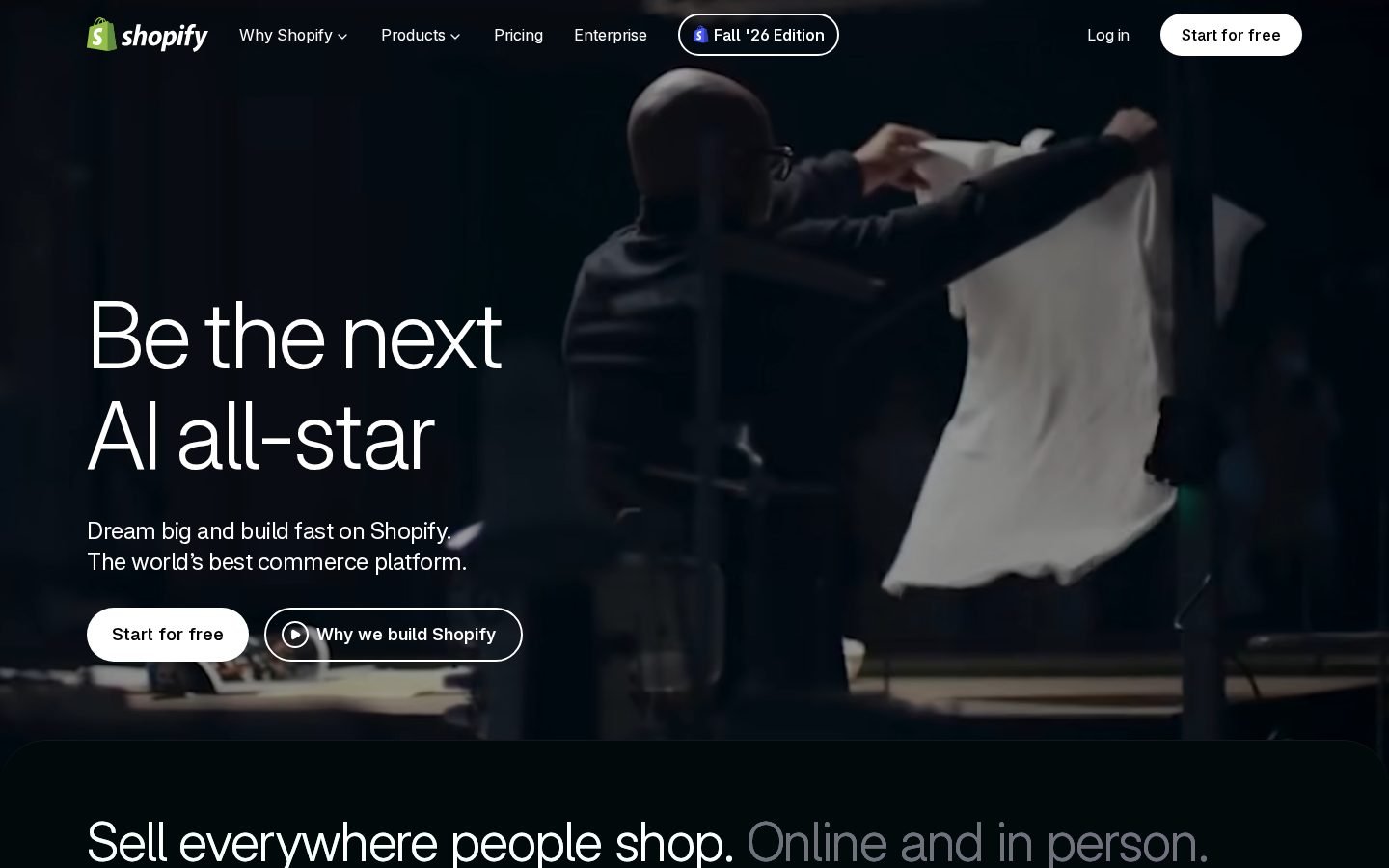
Shopify is a commerce platform for building online stores, selling across channels (online, social, AI, in-person), and managing business operations.
Choose Shopify if you want a simpler setup, an easier interface for non-experts, and a unified command center for payments and retail.
Official site Indie alternatives to Shopify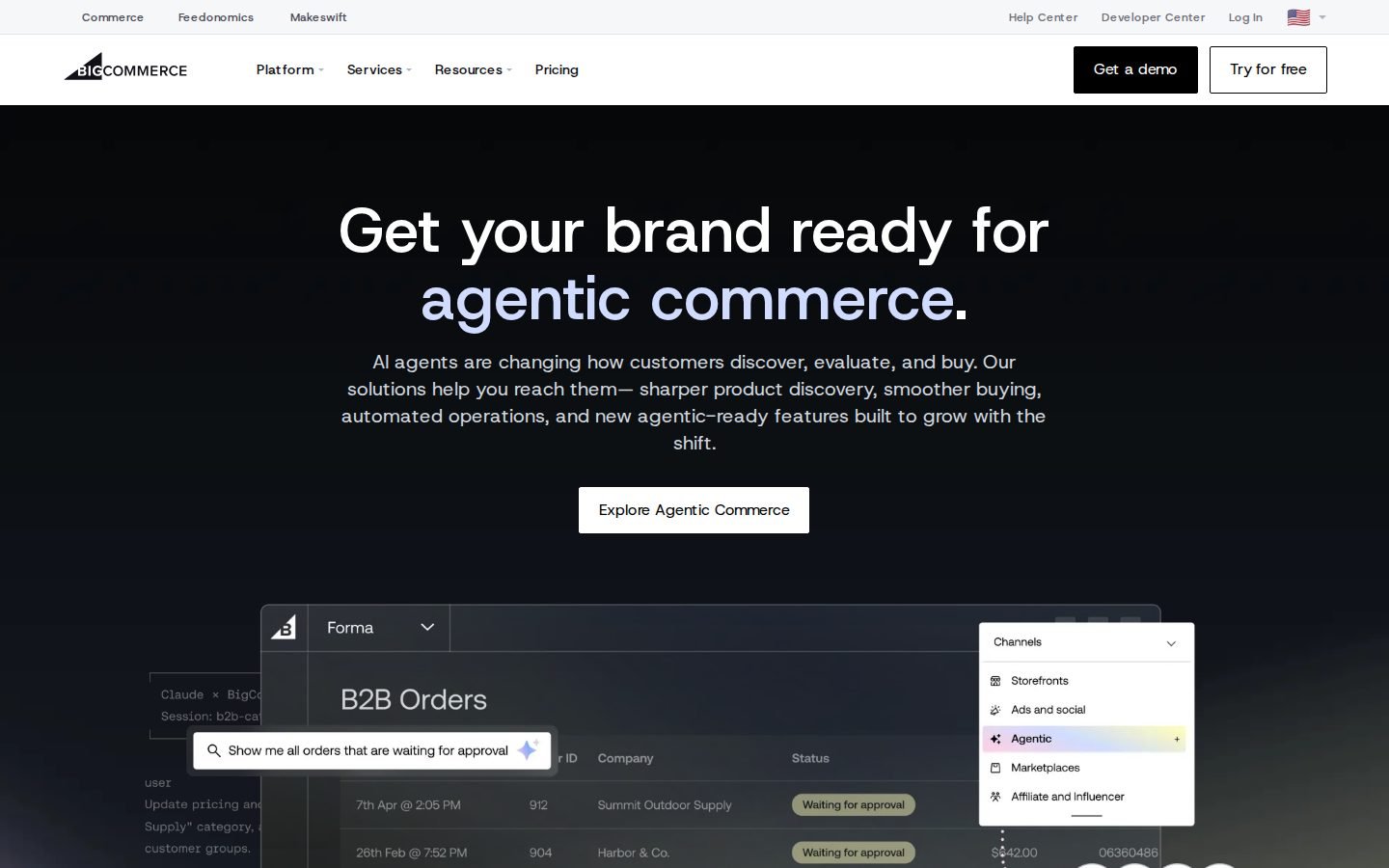
BigCommerce vs Shopify pricing
| BigCommerce | Shopify | |
|---|---|---|
| Free plan | Not listed | Not listed |
| Free trial | No credit card. No commitment. | 7 days |
| Plans | Not listed on the site | Not listed on the site |
Prices as shown on each official pricing page when last verified (our servers are in the EU, so some sites show local currency). Check the official site before buying.
Features compared
| Feature | BigCommerce | Shopify |
|---|---|---|
| Free Plan | No | No |
| Free Trial | No credit card. No commitment. | 7 days |
| B2B Commerce | Yes | Not listed |
| Multi-Storefront | Yes | Not listed |
| Headless Commerce | Yes | Yes (Hydrogen) |
| AI Assistant | Companion AI | Sidekick AI |
| App Ecosystem | 1,200+ integrations | 21,000+ apps |
| International Selling | Yes | Yes (Shopify Markets) |
Platform Focus and Target Audience
BigCommerce targets B2C and B2B brands, developers, and businesses of all sizes, highlighting features like agentic commerce and headless commerce. It positions itself as an open platform with over 1,200 app integrations. BigCommerce suits developers and complex B2B needs.
Shopify serves entrepreneurs, solo-preneurs, global enterprises, and developers, focusing on building online stores and managing operations across channels. It offers a unified command center for payments, fulfillment, and retail. Shopify appeals to users seeking an all-in-one solution.
Key Features and Capabilities
BigCommerce provides tools for catalog enrichment, product feed management, and international commerce, alongside a Companion AI Assistant. It supports multi-storefronts and channels & advertising. BigCommerce offers extensive catalog and B2B tools.
Shopify includes an AI-powered website builder, agentic storefronts for AI channels, and Sidekick AI assistant. It features Shopify Markets for international selling and Shopify Capital for funding. Shopify integrates AI tools and funding options.
User Feedback and Trade-offs
Users on Hacker News often mention that BigCommerce is better for high-volume businesses, though some report forced plan upgrades based on sales thresholds. Others note issues with slow software and unreliable API connections. BigCommerce handles volume but may have reliability concerns.
Conversely, users find Shopify easier for non-experts to run, citing simpler setup and marketplace access. However, some mention transaction fees on external payment processors and limited flexibility compared to competitors. Shopify is user-friendly but may incur extra fees.
What users say
BigCommerce
Summarized from public Hacker News discussions; links go to the original comments.
Indie alternatives to BigCommerce and Shopify
Smaller tools built by independent makers that cover part of what these two do, often for less.

SocialCart
A simple way to sell online. Built in Europe for independent creators and makers.
Users looking for a full-featured e-commerce platform like Shopify may switch to SocialCart for a simpler, social-first storefront that integrates directly with Instagram, TikTok, and WhatsApp without complex setup.
Free plan: 5% commission on sales. Pro plan: $18/month for 0% commission.

Prometora
The marketplace builder that gets you to first transactions.
While Shopify is primarily for single-vendor stores, its 'Shopify Markets' and multi-vendor apps make it a common base for marketplace owners; Prometora offers a native, purpose-built two-sided marketplace experience without the need for complex app stacks.
See website for pricing

AI Business Name Generator
Generate unique and memorable business names for your next project using AI
Shopify has a built-in business name generator for merchants, but this tool is a standalone alternative for anyone looking to name a business regardless of their e-commerce platform choice.
One-time credit packs starting at $9.99 for 100 credits, valid for 365 days. No monthly subscriptions.

Supaflo
All-in-one creative workspace for building sites, selling products, and growing audiences.
Users selling digital products or beats can switch from Shopify to Supaflo for a simpler, all-in-one solution that combines storefront, website builder, and email marketing without managing multiple apps.
Free to get started. Creator plan at $14.99/mo.

Repaint
Build a website by chatting with AI
Small business owners looking for an all-in-one solution that combines a website builder with integrated e-commerce, memberships, and appointment scheduling can switch from Shopify's modular ecosystem to Repaint's unified AI-driven platform.
Plans start at $25/month (Plus), $100/month (Pro), and $200/month (Max). A 14-day free trial is available.

SubSchool
All-in-one teaching platform automating routine with AI
Users who currently build custom course sites using Shopify + apps can switch to SubSchool for a unified platform that includes course hosting, tutoring, and AI grading without managing separate integrations.
20% commission on marketplace sales. Hidden courses start at $29/month.

Grigora
AI website builder with built-in stores and newsletters
While Shopify is primarily an ecommerce platform, Grigora competes for users who want to build a brand website and sell products in a single, integrated workspace with built-in AI and newsletter tools, rather than using Shopify as a standalone store.
from $12/mo billed yearly
eSIM Panel
White-label eSIM marketplace platform
Similar to Shopify, BigCommerce merchants selling travel connectivity need specialized solutions; eSIM Panel provides a niche-specific platform that handles provider APIs and global compliance out of the box.
Starter $99/mo, Growth $199/mo, Scale $399/mo

Maynuu
Online ordering and delivery platform for F&B businesses
Users of Shopify can switch to Maynuu to build a dedicated online ordering and delivery system specifically tailored for food and beverage businesses, avoiding general e-commerce complexity.
See website for pricing
More comparisons
FAQ
Is BigCommerce cheaper than Shopify?
Pricing details are not listed on either site, so a direct cost comparison cannot be made from the available information.
Does Shopify have a free plan?
No, Shopify does not offer a free plan, though it provides a 7-day free trial.
Does BigCommerce have a free trial?
BigCommerce offers a trial with no credit card and no commitment, though specific duration details are not listed.
Which platform is better for B2B?
BigCommerce explicitly lists B2B Commerce as a key feature, while this capability is not listed for Shopify.
Does Shopify charge transaction fees?
Users on Hacker News mention transaction fees on external payment processors for Shopify, though official fee structures are not listed on the site.
This comparison is generated automatically from the official websites and re-verified periodically. Spotted something wrong? Tell me.